
High-Speed Presses: MCB / MCCB Parts Precision Stamping

High-speed presses stamp the precision parts of MCB — primarily arc chute plates, phase barriers, and conductive copper contact plates and contacts. They're also used to produce terminals, thermal springs and fuse clips, together with electromagnetic assembly hardware, mechanism brackets and housing clips.

These small thin-stock parts are used in high volumes with tight tolerances, formed in a single pass on progressive dies running at high speed.
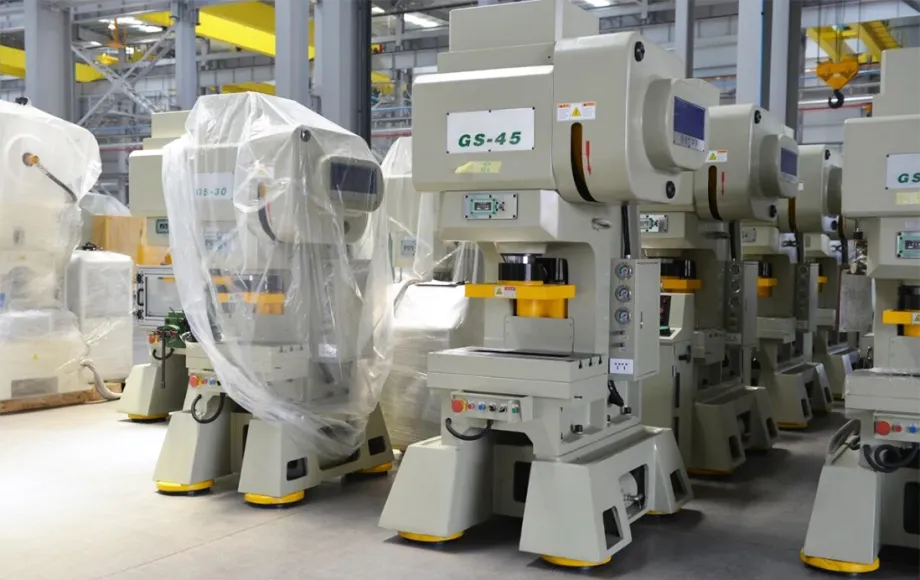
Overview

3 Frame Configurations optional for Different Part Characteristics

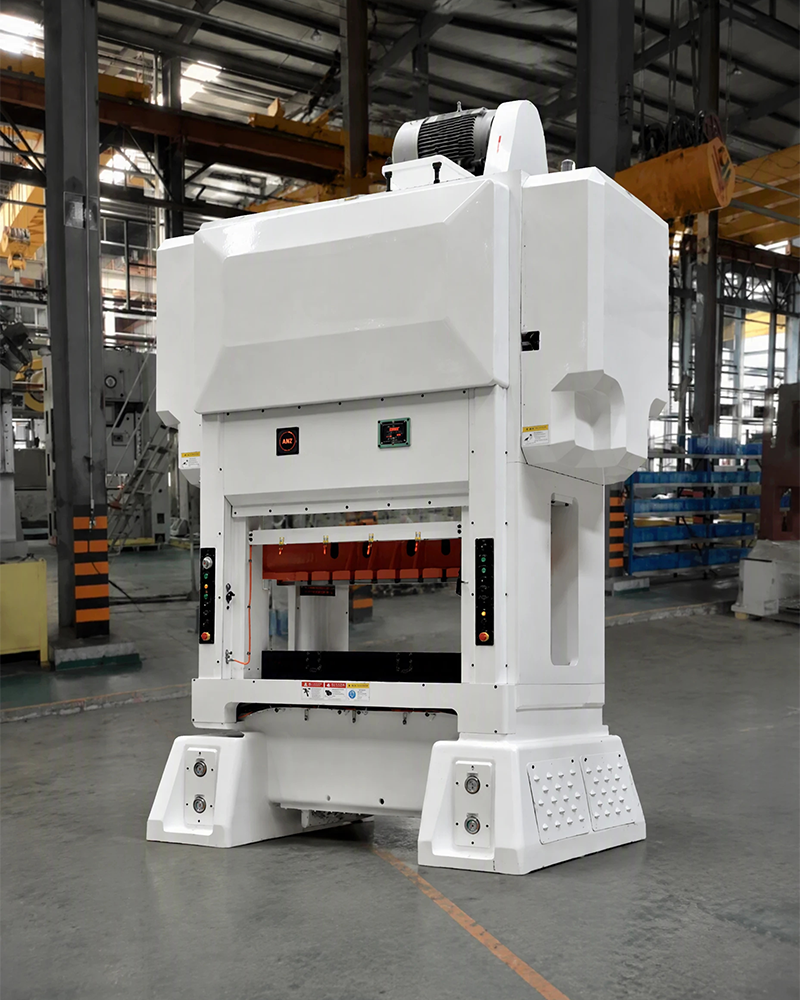
Gantry (Closed H-Frame) GP Serie

A closed-frame construction with high rigidity, strong resistance to eccentric loading and a wide bolster, supporting high-speed mass production with multi-station progressive dies. Compared with C-frame designs it handles larger parts, more operations and thicker material, as well as parts involving draw forming and asymmetric loads.

The slide runs on a balancing mechanism that cancels left and right forces, combined with twin-plunger eight-face needle-roller guides and double guides, which maintains accuracy over long high-speed runs.

The side opening is relatively small, so manual stock loading is less convenient than on a C-frame — that is the trade-off.
Toggle-Link (Knuckle-Joint) GT Serie

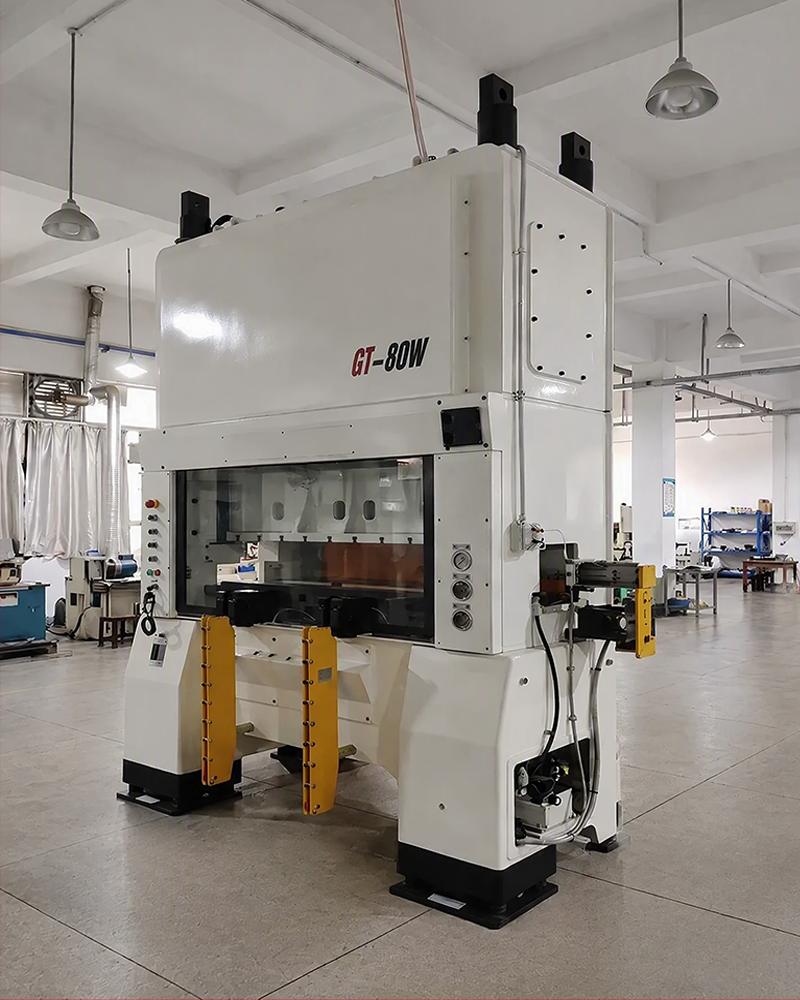
The toggle-link mechanism makes the slide decelerate sharply as it approaches BDC, giving a long pressure dwell, a momentary build-up of pressure and minimal side force. BDC repeatability reaches ±0.002–0.005 mm, with minimal thermal displacement and little slug pull.

It therefore excels at coining, shallow drawing, embossing, staking and sizing — operations where springback and flatness are critical — producing minimal burrs and leaving leads undeformed.
3-Round-Column (C-Frame) GS Serie

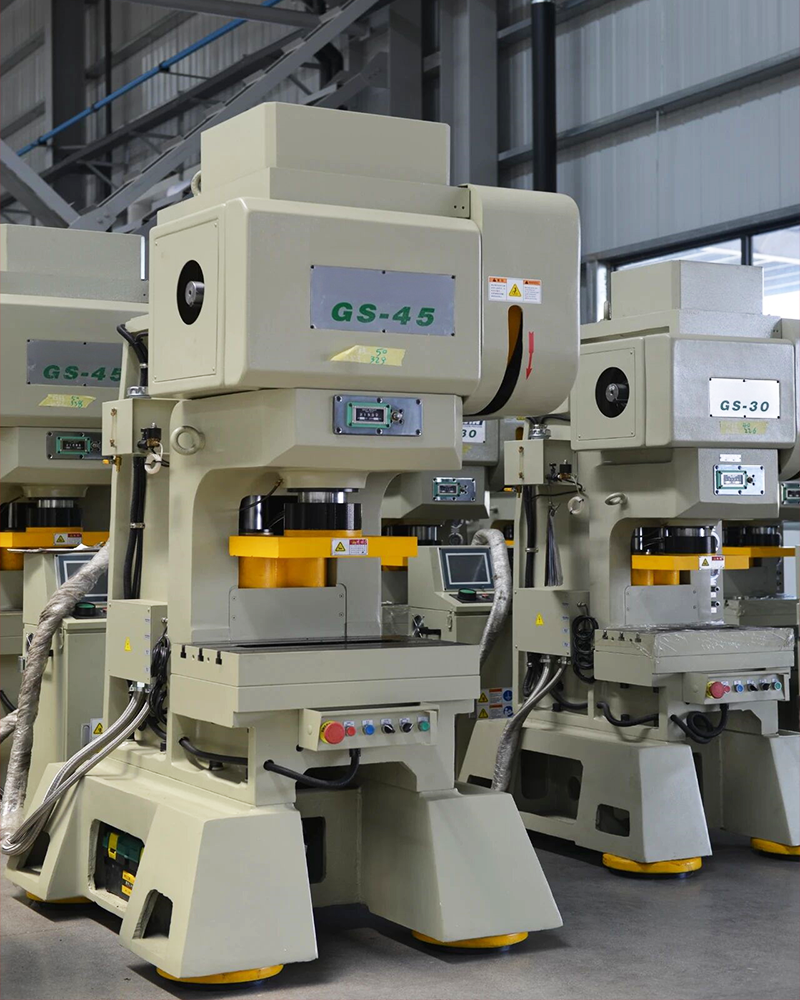
A C-frame open construction with stable guidance, easy coil threading and convenient die setup, at speeds of up to 800 SPM.

The split-type high-strength cast iron frame is stress-relieved to guarantee long-term accuracy; the eccentric high-strength alloy-steel crankshaft is quenched and ground and supported at four points by imported bearings; a dynamic balancing system reduces vibration and noise, keeping the slide in optimal condition throughout the stroke.

Four columns with hydraulic-locking adjusting screws, together with a machine-wide forced thin-oil circulation lubrication system, keep BDC accuracy under control.

Supply Range

  • Press Capacity:160 kN – 1,500 kN (approx. 16 – 150 tons), graded by part size and number of die stations
  • Sheet Thickness: 0.05 mm – 2.5 mm; the C-frame is recommended for 0.05–1.2 mm thin stock, with thicker material handled by closed gantry models
  • Maximum Speed: 800 SPM; typical production runs at 400 – 800 SPM
  • Materials: Silicon steel, brass / copper / beryllium copper, stainless steel, cold-rolled steel (SPCC), aluminium strip, tinplate
  • Bolster Width (L–R): 60-ton class 1,100 mm; 60-ton wide 1,350 mm; 80-ton class 1,200 mm; 80-ton wide 1,500 mm; 125-ton class 1,600 mm
  • BDC Repeatability: Up to ±0.002 – 0.005 mm on toggle models; on C-frame models BDC accuracy is controlled by hydraulic-locking adjusting screws and the oil circulation system

Role in Circuit Breaker (MCB / MCCB) Production

A breaker's breaking capacity depends on the number and profile accuracy of the arc chute plates, while contact resistance and temperature rise depend on the flatness and surface density of the copper contacts. Both depend heavily on high-speed stamping: chute plates are supplied in volume by high-speed progressive-die blanking, and copper contacts rely on coining for flatness. From the arc-extinguishing system to the contact system, and on to the mechanism and mounting parts, the stamped parts of a breaker range can essentially be covered by this series in a single package.

Core Technology and Configuration

Frame and Rigidity
Closed models use a closed frame with good thermal balance, and their bolster width is among the widest in each tonnage class. The C-frame models use a split-type high-strength cast iron frame that is stress-relieved to ensure long-term accuracy without drift.
Balancing and BDC Control
A fully opposed balancer minimizes shut-height shift caused by SPM changes, as well as BDC shift between the first and second strokes. The toggle-link mechanism produces minimal thermal displacement, and it keeps dimensional consistency stable over long continuous production.
Guidance and Eccentric-Load Resistance
A balancing mechanism that cancels left and right forces, twin-plunger eight-face needle-roller guides and double guides further increase the slide's eccentric-load capability, suiting multi-station progressive dies and dies with asymmetric loading.
Drive and Lubrication
The eccentric high-strength alloy-steel crankshaft is quenched and grounded, supported at four points by imported bearings. 4 columns with hydraulic-locking adjusting screws, plus machine-wide forced thin-oil circulation lubrication, provide full lubrication and control BDC accuracy.

Model Selection Guide (Universal Industries)

Item GP Series GT Series GS Series
Machine TypeGantry (closed H-frame)Toggle-link (knuckle-joint)C-frame (three round columns)
Standout CharatorsUltra-high rigidity, strong eccentric-load resistance, good thermal balance, wide bolsterRigidity far higher than C-frame three-round-column presses; excellent eccentric-load resistanceSplit-type high-strength cast iron frame, stress-relieved for long-term accuracy
Product Range300 kN~1,500 kN (approx. 30~150 tons)16~80 tons (small to medium capacity)
Bolster Left-Right Width60-ton class 1, 100 mm;
60-ton wide 1,350 mm;
80-ton class 1,200 mm;
80-ton wide 1,500 mm;
125-ton class 1,600 mm (widest in each class)
OperabilityExtended slide adjustment; electronic dial-type crank angle display
SpeedContinuous high-speed at 400 SPM and above400~800 SPM mass productionUp to 800 SPM
Sheet Thickness0.08~2.5 mm0.05~2.0 mm0.05~1.2 mm
Material TypeBrass, Red Copper, Cold-Rolled Steel, stainless steelcopper, stainless steel, silicon steel, SPCC, aluminum stripcopper, aluminum, cold-rolled steel, stainless steel
Core ProcessesContinuous piercing, multi-step bending, embossing, staking/interlocking, shallow drawing, coining, multi-station compound operationsShallow drawing, staking, coining, embossing, ribbing, multi-step bend forming, high-density fine-hole piercingProgressive continuous piercing, blanking, bending, ribbing, embossing, shallow coining, small-angle bending, ultra-thin sheet blanking
Not Suitable / LimitationsSmall side opening;
manual coil/die loading less convenient than C-frame.
Not explicitly stated in the source (positioned as a precision high-speed model;
heavy forming/deep drawing is not its focus).
Thick-sheet deep drawing and heavy large-tonnage forming;
heavy blanking of sheet thicker than 1.5 mm;
deep drawing / multi-pass drawing (prefer closed gantry presses);
large structural parts, eccentric-load multi-station heavy stamping.