# How Is an MCB Made? From Assembly to Final Testing

About Author
Zhou Jian
- Founder, CEO of Huiju Automation and Sikong Robotics;
- Talent leader for "5G+Smart Logistics Project Group" at Yangtze River Delta Electrical Engineers Innovation Center;
- Researcher of robot control systems (RCS), smart cloud big data management systems since 2010.
Table Of Contents
- [The Main Parts Inside an MCB](#The%20Main%20Parts%20Inside%20an%20MCB)
- [How an MCB Is Assembled Step by Step](#How%20an%20MCB%20Is%20Assembled%20Step%20by%20Step)
- [What Tests Does an MCB Need to Pass](#What%20Tests%20Does%20an%20MCB%20Need%20to%20Pass)
- [How Automation Is Used in MCB Production](#How%20Automation%20Is%20Used%20in%20MCB%20Production)
---
Contact Us
Name
Email \*
Message \*
Website
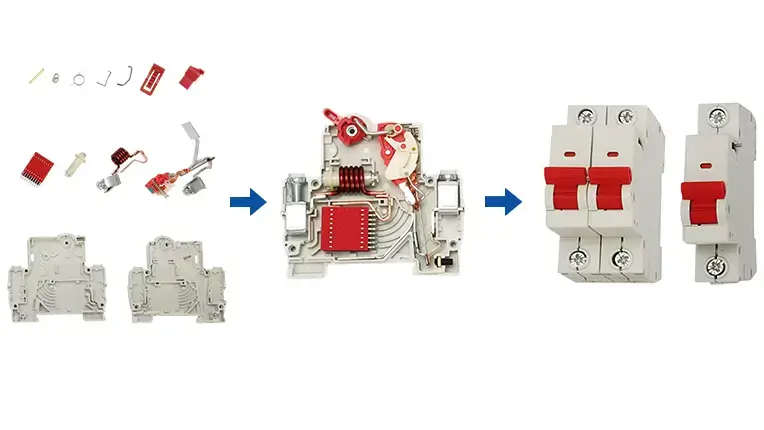
We may never think about the ****miniature**** ****circuit breaker**** in the distribution board, until it trips. But that little device is meant to function every time, for years, when an overload or a short circuit happens.
That reliability depends on careful manufacturing, with each component assembled and the finished breaker tested before shipment.
In this guide, we cover the main parts inside an MCB, the usual steps on an MCB assembly line, the tests a finished unit needs to pass, and how automation fits in.
## ## **The Main Parts Inside an MCB**
An MCB might seem simple from the outside, but inside the casing there is a lot going on. Most thermal-magnetic models have these core parts in common:
- **Contacts:****The circuit is closed and opened by a fixed contact and a moving contact. They have to conduct current without heating up.
- **Thermal trip element:****The bimetal strip bends due to heat and trips the breaker during an extended overload.
- **Magnetic trip element:****A magnetic mechanism responds to high fault currents and trips the breaker rapidly when a short circuit occurs.
- **Operating mechanism:****The handle, latch and spring work together to achieve quick opening and closing of contacts.
- **Arc chute:****Metal plates that divide and cool the arc when contacts are separated.
- **Housing and terminals:****The housing is insulated to protect the parts and the terminals connect the wiring.
Layouts vary by brand, current rating and number of poles, so think of this list as more of a general picture than a fixed blueprint. For more background, [Wikipedia’s page on circuit breakers](https://en.wikipedia.org/wiki/Circuit_breaker) is a good place to start.
## ## **How an MCB Is Assembled Step by Step**
In a common MCB production line process, the work goes from loose parts to a closed and marked product. Components are checked and fed in, contacts and trip units are fitted and the housing closed once everything moves as it should.
In practice, this is the stage that gets the most attention—the mechanism stage. If the contact is a little off, it can cause tripping later, so each stage has its own check.
The table below gives a general view of the stages.
| ****Production stage**** | ****Main task**** | ****Quality focus**** |
|---|---|---|
| Component preparation | Check and feed parts | Part condition and dimensions |
| Mechanism assembly | Install contacts and trip mechanisms | Correct positioning and movement |
| Housing assembly | Enclose and secure assembled components | Assembly completeness and fit |
| Final inspection and packing | Check product identification and visible condition | Marking, appearance, and traceability |
This is an overview of a typical flow, not a set order for each manufacturer. Sequence of final inspection, testing and packing may vary from line to line.
## ## **What Tests Does an MCB Need to Pass**
Once assembled, each MCB has to show that it behaves the way it was designed to. Many manufacturers work from [IEC 60898-1](https://webstore.iec.ch/en/publication/62129), the international standard for circuit breakers used in household and similar installations. Here are the checks you will see most often:
| ****Test**** | ****What it checks**** | ****Why it matters**** |
|---|---|---|
| Thermal trip test | Response to specified overload conditions | Verifies the performance of thermal overload protection |
| Magnetic trip test | Response to specified high fault currents | Verifies the performance of magnetic short-circuit protection |
| Mechanical operation test | Opening, closing, and mechanism movement | Checks the operating mechanism for proper function |
| Continuity test | Electrical continuity through the intended current path | Helps identify open circuits or poor electrical connections |
| Withstand voltage test | Insulation performance under a specified test voltage | Checks whether insulation withstands the prescribed electrical stress |
The tests performed on each unit depend on the manufacturer's quality control plan. Production-line checks may include functional and electrical tests, while other tests are carried out as required by the applicable product standard.
## ## **How Automation Is Used in MCB Production**
Many factories now use machines for both assembly and testing. An MCB automatic testing line, for example, runs the checks above in a set order, without relying on someone to set each one by hand. The main benefits are:
- **More consistent assembly:****Machines do the same thing each cycle, so there is less variability across units.
- **Higher production throughput:****Automated handling and coordinated workstations can reduce manual handling time and delays between assembly steps.
- **More systematic quality checks:****Each unit goes through the same checks in the same order.
- **Better process traceability:****Test findings are connected to particular products, making it easier to trace problems.
Good process design is still needed with automation. It works best when steps and quality points are explicit from the start.
Making a reliable MCB involves a series of steps, from assembling individual components to inspecting and testing the finished product. Understanding what happens at each step helps explain why the final output can be trusted.
If you are planning to upgrade a line, ****Huiju Automation**** builds [MCB automatic assembly line](https://www.viiju.com/products/mcb-auto-assembly-line) and [MCB automatic testing line](https://www.viiju.com/products/mcb-auto-testing-line). [Contact us](https://www.viiju.com/contact) to discuss your production requirements.